
Gritstone author Mike Raine takes a look at the thorny subject of AI and writing
‘Books remain essential not just as sources of information, but as training grounds for judgement. Reading builds a quiet internal compass, an understanding of context, plausibility, and truth that no search engine can replicate. While the tools we use may change, the foundations of good writing remain the same: curiosity, care, and a lifelong habit of reading.’
MIKE RAINE, GRITSTONE AUTHOR
There’s no way, currently, that AI can write with feeling, personal experience, or genuine empathy. So why take any notice of it? It can’t do what we can do – yet.
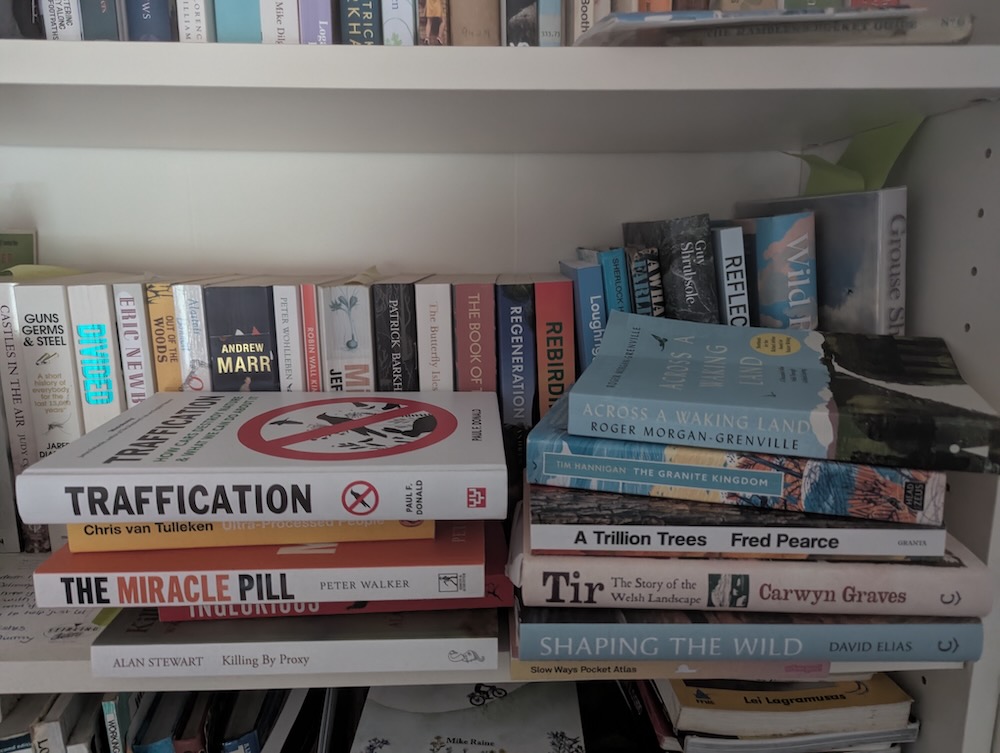
Surrounded by books, I sit and I write. I’m not the only one with a large personal reference library – you only have to experience a Gritstone team online meeting to see that. But to what degree do writers really refer to these shelves of ageing books, when surely everything is online today?

I believe that to be a good writer, you need to be a reader. Reading brings context, depth, and understanding. It reminds us that we don’t always get things right and that accuracy matters. We tend to take for granted that the printed word is factual, that the author has done their research thoroughly. We don’t expect to be misled in works of non-fiction – as the recent Salt Path controversy demonstrated. While some books are opinion-led, they are usually grounded in facts, wider reading, deep conversations, and personal observation. Others may be skewed by vested interests, but these rarely stand up to scrutiny. Fundamentally, we expect a book to be correct.
Fact checking is important
A couple of years ago, I was asked to review a book about the Lake District. In many ways it was a jolly good read, but several factual errors were conspicuous. Sharp Edge and Napes Needle were described as granite, and a character was apparently employed full time by the mountain rescue team. To anyone with a passing knowledge of geology or mountain rescue, these are not trivial slips. They are important details and once written in a book they are assumed by the reader to be true. Both could have been checked with a simple online search. Alternatively, a well-read writer might have sensed intuitively that something wasn’t quite right and needed further investigation.
Fact-checking has never been easier. The internet sits at our fingertips as we type away. And yet, during a talk at the Hay-on-Wye Literature Festival, poet and writer Owen Sheers told his audience that the only way to write is to retreat to the shed at the bottom of the garden, away from any online connection. In the same talk, he also said that writing is rewriting; something I found deeply reassuring. This approach may suit fiction particularly well, though even fiction needs a consistency if it touches the real world.
Imaginary errors and that sense of ‘wrong’

I’ve always liked the anecdote about J.K. Rowling describing King’s Cross Station while actually having St Pancras (or was it Euston?) in her head as she wrote. In that case, it didn’t matter. It didn’t detract from the story, and Platform 9¾ is imaginary anyway.
What does matter is that writers develop a sense for when something needs checking. That instinct comes from reading widely and deeply over time, not simply from searching for answers in the moment.
Books remain essential not just as sources of information, but as training grounds for judgement. Reading builds a quiet internal compass, an understanding of context, plausibility, and truth that no search engine can replicate. While the tools we use may change, the foundations of good writing remain the same: curiosity, care, and a lifelong habit of reading.
Mike Raine is the author of ‘The Mountain Leader’ and ‘Nature of Snowdonia’. Both are available from our shop.
The views expressed in this post are those of the contributor and do not necessarily represent the views of all members of the Gritstone co-operative.