Gritstone author Mike Padgett walks into the Yorkshire Wolds only to be confronted with gunfire.
‘The sound of gunfire usually stops when the hidden lookouts in their green and brown attire spot a walker on the footpath… Not this time. The gunshot continues, and the sound cracks across the valley and over the path like invisible lightning.
MIKE PADGETT, GRITSTONE AUTHOR
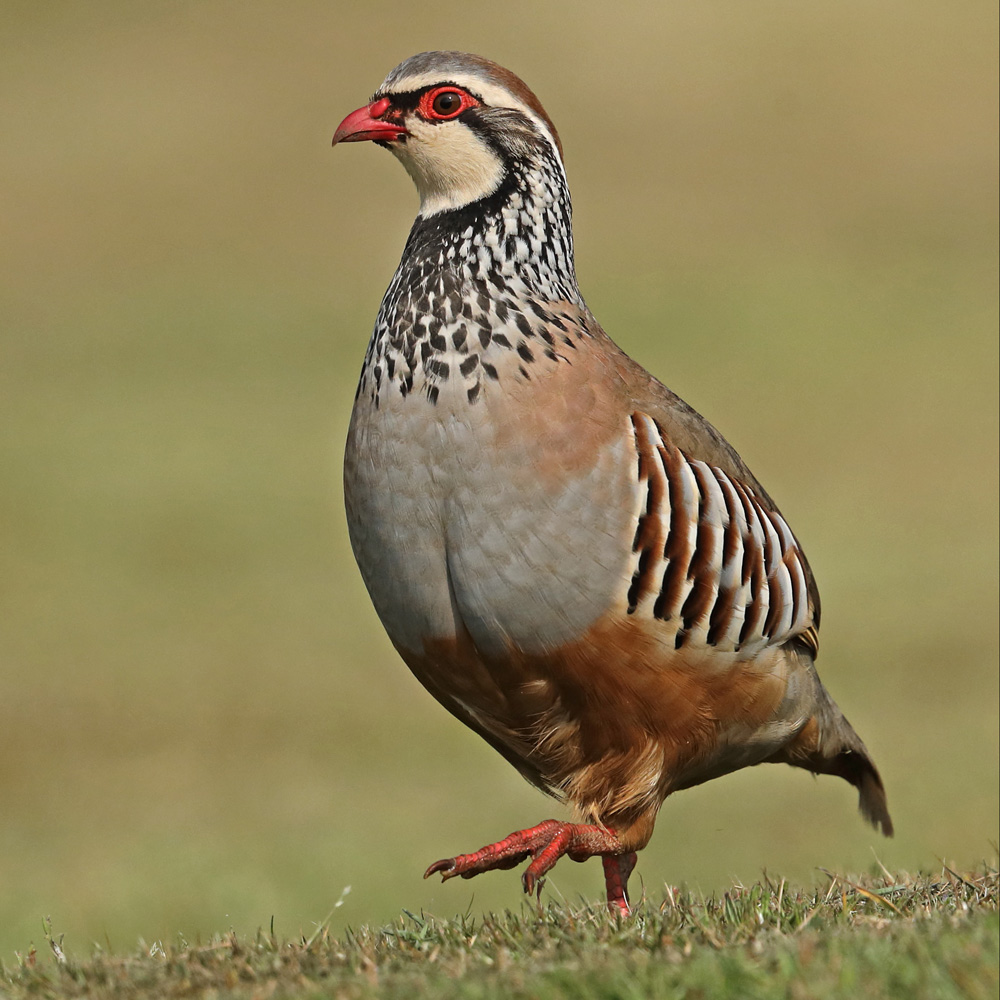
French Partridge
They are killing birds again this morning as I enter the Yorkshire Wolds valley leading to Arras. The sound of gunfire usually stops when the hidden lookouts in their green and brown attire spot a walker on the footpath. They break cover, drop their white flags, raise their red flags, and the valley goes quiet. Not this time. The gunshot continues, and the sound cracks across the valley and over the path like invisible lightning. The guns are to my left. I can’t see the pegs through the thick hedge but they must be very close.
I turn my head away, and half-shut my eyes, expecting pellets to come rattling down on me through the overhanging hedges. But instead of pellets a bird falls untidily out of the sky and hits the ground with a muffled thud ten yards in front of me. I expect to find a scene of blood and twisted wings but the bird has landed on its belly, head to one side, motionless, not a feather out of place. Its red legs, red bill and red eye ring look untouched and bright on the chalk path. I slow down but don’t stop. The French partridge is already dead.
There are pickup trucks and land rovers parked in a line in a clearing in the hedge a few yards farther up on the left. Some of the vehicles’ boots are open and dogs behind grills look at me with no interest. A trailer is attached to the pickup nearest the path and on display is the morning’s tally. At least a hundred French partridges, laid out side by side in rows, face down, all pointing the same way, perhaps four deep.
A French Connection
The French partridge, introduced from continental Europe in the seventeenth century, is providing good game for the guns this morning. And the colourful little bird is not the only life form from France to have died violently in this location.Many centuries before the ancestors of this morning’s kill arrived in the UK, an Iron Age people from the Champagne area of France, known as the Parisi, fought with rival tribes in this valley. Parisi square barrow cemeteries containing speared bodies and chariot burials have been found less than a mile from the morning’s bag of lifeless partridges in front of me.
Now a man is standing at the side of the loaded trailer, dressed like the lookouts but without a gun or a flag in his hand. He is the gamekeeper. I’ve seen him driving his quad bike through the village and up onto the hills to replenish the feeding hoppers tucked away in the hedges. I avert my eyes, determined not to engage with the gamekeeper, to show no sign of approval of what he’s doing, or say something that I might regret. But he says good morning and I can’t help saying good morning back. All three players in this conflict, any conflict, are there in that little scene: the hunter, the hunted and those who turn their backs and walk away without comment.
The shooting has stopped. The lookouts have raised their red flags and the only sound is the whoosh of wind turbines on the valley top. I continue along the path towards Arras and argue with myself. This is what I should have said. Look Mr Gamekeeper. I respect, even admire your gun skills, your bird-rearing skills, your sense of purpose, your teamwork. But I hate to see you killing those birds. You’ve looked after them all year in all weathers and then you organise their slaughter. Why? To give the lord of the manor the pleasure of showing off his estate to his shooting guests? Showing off how well he has trained you and your beaters. In my inner argument the gamekeeper doesn’t reply and I feel better.
When I’m a quarter of a mile farther up the path the shooting resumes, killing off any chance of birdsong returning to the valley this morning. Or any hope of a sighting of the local peregrine falcon locked onto its prey. I leave the valley where it meets the Wolds Way, the sign post pointing south east to Hessle, north east to Filey, and look back to where the killing is taking place. How many more game birds will fall heavily out of the sky onto the floor of this ancient trail today? There will be no dignified ending for my dead partridge, killed for sport, waiting to be picked up and stacked on top of its dead family before being put on display, plucked and eaten. No Billy Casper’s Kes. No Helen Macdonald’s Mabel. No little graves dug alongside the iron-age burial sites on this very same path up the valley to Arras.
The views expressed in this post are those of the contributor and do not necessarily represent the views of all members of the Gritstone co-operative.
Image of red legged adult partridge © Neil Bowman(istockphoto).
