
Gritstone author Mike Padgett looks back at the bit part he played in Kes and the big part the film played in his life
‘Ken Loach and Tony Garnett offered Barry Hines an opportunity to write a script for The Wednesday Play but he turned it down. He was busy working on a new novel about a boy and a kestrel. They were intrigued and asked if they could be the first to see the finished manuscript. It was called ‘A Kestrel for a Knave.’
MIKE PADGETT, GRITSTONE AUTHOR
When Play for Today returned to TV in November last year I thought about all those classic social realist dramas in the original BBC 1 Play for Today series and its precursor, The Wednesday Play. Those ‘kitchen sink’ dramas, broadcast in the sixties, seventies and early eighties, sought to depict the everyday lives and struggles of working class individuals. Among them were hard-hitting dramas such as Cathy Come Home and Up the Junction, both directed by Ken Loach and produced by Tony Garnett.
In their search for social realist writers, Ken Loach and Tony Garnett approached Barry Hines, a teacher and emerging talented writer of working class life. Barry had written a novel, The Blinder about a brilliant footballer with a chip on his shoulder. Ken and Tony offered Barry an opportunity to write a script for The Wednesday Play but he turned it down. He was busy working on a new novel about a boy and a kestrel. They were intrigued and asked if they could be the first to see the finished manuscript. It was called ‘A Kestrel for a Knave’.
Barry Hines, writer and teacher

Ken and Tony liked the finished manuscript and agreed to team up with Barry and turn the book into a film. This was in 1967, the same year Barry came to my school, Longcar Central in Barnsley to be our PE teacher. We got on well, both being good footballers. He was an excellent teacher; kind, helpful, friendly, and he cared about the school kids he taught. He was the first teacher to let us call him by his first name.
But don’t be fooled – he was no softy. He had a sceptical sparkle in his eyes and always seemed to know what we were up to. Occasionally he took us for English Literature where he made us think about language and books and the relevance they had to working class lives. And he showed us the value of writing about our own experiences.
Barry was on our side and believed in the right of all working class people to reach their true potential. Even now, whenever I re-read Barry’s books with its spare, terse prose style and unpretentious writing, I’m reminded of those lessons. He had a big influence on my writing.
When I think about it, I never saw an overtly political side to Barry at school. Perhaps he developed that aspect after teaming up with Ken and Tony. His left wing views kept surfacing like a big whale in his next book, First Signs, but became more subtle, and therefore, for me, more powerful, in his later works such as The Gamekeeper and The Price of Coal.
Picked for a part
Filming took place at St Helen’s Secondary school during the six week summer break of 1968, and Barry invited me and three of my former fifth form school mates from Longcar (we left school that summer) to audition for a part. Rob Naylor was picked to be MacDowell the bully, I was picked to be in the football scene, and Mick Joyce and Glyn Bowser were to join me in MacDowell’s gang. We laughed when we discovered that Brian Glover, a former teacher of ours, was to play the part of Mr Sugden, the bullying PE teacher.
I played the good footballer and had the cheek to tell Mr Sugden that Denis Law is better than Bobby Charlton. Mr Sugden knows best of course. He doesn’t like being challenged and he sticks his chest out and shuts me up. I’m convinced to this day that’s why he wouldn’t let me take the penalty. But only Ken Loach and Barry Hines know for sure.
One day on set Barry asked me what I thought A Kestrel for a Knave was about. ‘A kid and a kestrel, and being bullied,’ I said. He just smiled and said, ‘It’s about Education.’ Overnight, that simple word changed the way I looked at writing. It was the best English Literature lesson I ever had.
The filming took around six weeks to complete. I was involved for the first three weeks and got paid £5 per day – more than a month’s pay for a paperboy.
Ken Loach, director
What I remember most clearly about Ken during filming was the contrast between his intense focus and concentration when discussing the script with Barry or camera angles with Chris Menges, and his gentleness and sensitivity when the pressure was off. Ken appeared to be seeking perfection, always asking for another take: more action, less action: stronger lighting, weaker lighting: more background noise, less background noise. His favourite saying was, ‘That was good. Now just one more time.’ But there were moments when he relaxed and laughed along with us. Like the time one of the film crew circulated a men only magazine with a photo of a naked couple in bed and a caption hand written in biro saying, ‘That was good. Now just one more time.’
Ken used some crafty methods to get us to act naturally, or as I’m sure he would say, not to act at all but to be authentic. When filming the scene where MacDowell, wrongly accused of coughing, is dragged out of assembly by a teacher, Ken wasn’t happy with the way the hardened bully appeared nervous while those of us standing near him looked unconcerned and relaxed knowing we weren’t going to be pounced on. Then we overheard Ken telling the teacher to leave MacDowell alone next time and instead pick on someone else. Now it was MacDowell who relaxed while everyone else tensed up. Of course the teacher still dragged MacDowell out and the realistic take was made.
Future stars?
Everyone I knew turned up to watch the film when it came to Barnsley and those of us up on the big screen became famous overnight. Never mind working down the pit – we were all going to be actors now. The day after the screening I got a phone call. A well-spoken man with a southern accent said he was from the London Film Academy.
He’d just watched the premier of Kes and he was very impressed with my acting and said he would like to offer me a contract with their academy. I tried to keep calm. He must have sensed my heart was pounding at the prospect of fame. Then in a broad Barnsley accent he said, ‘Dun’t get too excited, Michael. It’s ony thi Uncle Ron.’
A bit part in Kes – a big part in my life
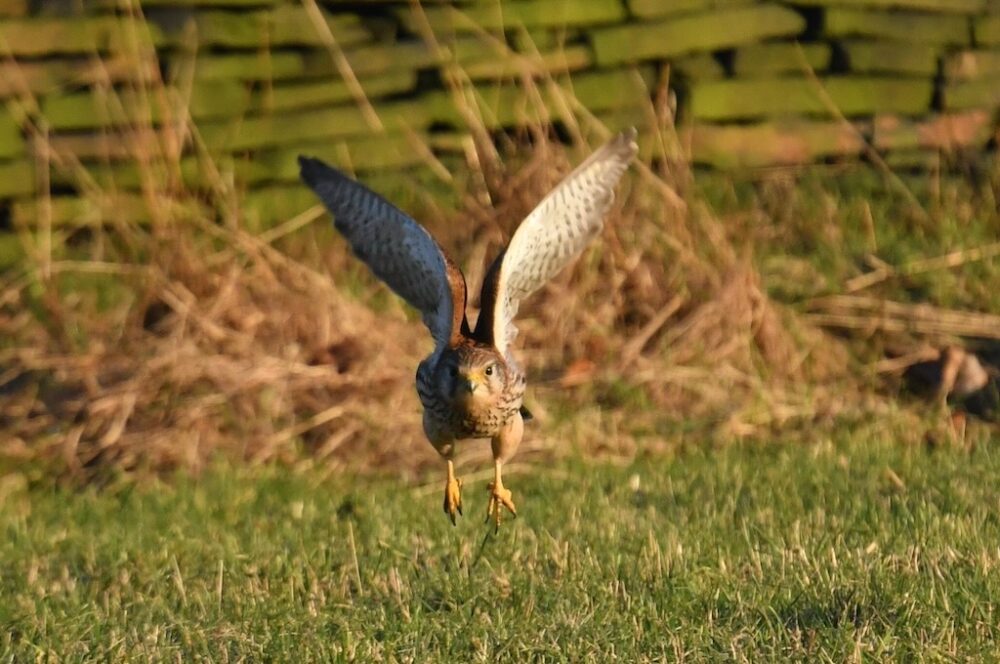
It’s not surprising that being involved in Kes made a big impact on my life. After all, the film was shot in my home town and the book and script were written by my teacher. Similar dramas occurred every day where I lived and the story and the characters were neither far-fetched nor romanticised. The sharpest impact the film had on me was realising the importance of sticking up for the underdog – to be a Mr Farthing whether that was in school, in the workplace, or in the rest of society. And just as important, to be aware of how easy it would be to become a Jud, a MacDowell, a Mr Sugden or a Mr Gryce. But perhaps the biggest impact the film had on me came about as Kes began to achieve worldwide acclaim. The world around my estate seemed to open up and I began to feel restless. Began to believe I could achieve something.
Ken’s approach to filming Kes, the way he got the best out of every kid in every scene, valuing us for what we were and what we had to offer, not wanting us to act but to be ourselves because we were worthy and authentic and had something to say, not only created a faithful, brilliant adaptation of A Kestrel for a Knave, but also reflected the theme of working class potential so beautifully portrayed in Barry’s little book. I just wish Ken and Barry had let me take the penalty.
Mike Padgett is the author of a travel memoir As Far As We Can, and two novels, SCRAP and Kicking Off. All are available from our shop
If you want to read more about how Kes affected people’s lives I can recommend A Tribute to KEN LOACH and KES edited by Ronnie Steele
The views expressed in this post are those of the contributor and do not necessarily represent the views of all members of the Gritstone co-operative.
