Andrew Bibby
The views expressed in this post are those of the contributor and do not necessarily represent the views of all members of the Gritstone co-operative.
Sometimes we forget our history. It wasn’t really so very long ago that the issue of land ownership and land taxation was one of the hottest of all hot political topics. Lloyd George precipitated the most serious constitutional crisis of modern times when his ‘People’s Budget’ in November 1909 proposed a series of taxes on land value – and the House of Lords, packed with landowners, promptly voted it down. Cue an emergency General Election and, eventually, the compromise deal of the 1911 Parliament Act which rebalanced a little the powers of the two houses of Parliament.
In the interim, though, Lloyd George’s budget proposals disappeared from sight and then the First World War came along to change everything. Land value taxation periodically popped up as a proposal thereafter in Labour election manifestos or on TUC agendas, but the passion had somehow gone out of the debate. In recent decades, what was often called the ‘land issue’ seems to have disappeared almost entirely from political discourse.
Lloyd George’s proposal in 1909 built on many decades of active campaigning in the second half of the nineteenth century. Horse-drawn ‘red vans’ and ‘yellow vans’ run by activists in, respectively, the English Land Restoration League (ELRL) and the Land Nationalisation Society took the cause out to village greens across the country in the 1890s. (These groups had some clout: George Bernard Shaw and Sidney Webb were among the founder members of the ELRL).
A little earlier, the American writer Henry George had visited Britain on a speaking tour linked to his influential book Progress and Poverty (1879). George’s central proposal for was a tax on the increase in land value brought about not through any improvements but through societal change – or in other words by the transformation of agricultural land into valuable building land for the expansion of London and other major cities.
England’s landowners – or at least those with land which was in the right places – saw their personal wealth increase enormously in this period from doing nothing at all. As campaigners were quick to point out, land ownership was anyway in the hands of only a few. An 1872 survey (the so-called Second Domesday Book) found that six million acres of Britain was in the hands of just 400 peers.
Why not route at least some of this increased wealth that had come from increased land value back into the public purse, the argument ran. Taxation was the answer, according to Henry George. Don’t kick out the landlords, just tax them, he once said.
Today you can still hit the jackpot if the agricultural land you own is re-zoned for housing. Agricultural land in Great Britain on average currently sells for about £6000-£7000 an acre (more if it’s arable, less if it’s rough grazing). But if the land can be used for development, its value can go through the roof.
“Landowners are pocketing billions of pounds of profit every year just for getting planning permission, which raises prices and makes it harder than ever to buy land for new social housing”: this claim comes from a press release put out by the Centre for Progressive Policy and the National Housing Federation. Their research suggests that landowners in England made more than £13 billion in profit in a single year (the data are from 2016/17). As they go on to say, “Landowners’ total profits are more than the global profits of Amazon, McDonald’s and Coca Cola combined.”
Estate agents such as Savills frequently make the point to would-be investors. “It is worth noting that rural assets have advantages over other assets based around taxation and ownership benefits. Farmland is a tangible asset, a good inflation hedge and its performance is relatively recession proof,” says a recent Savills’ survey.
The issue of how we meet the desperate need for more housing while ensuring that we lose as little of our countryside as possible is of course a challenging one. But the disparity in the market value of agricultural and development land makes it very much harder to take the necessary decisions sensibly and objectively.
So maybe we need to think once more about land value taxation. Certainly, it’s being discussed in perhaps unlikely places. The FT’s eminent columnist Martin Wolf, for example, recently chose for his recommended summer reading a new book by George Curtis, Poverty is not Natural.
As Wolf writes, “George Curtis has a soft spot for Henry George. So do I. [Henry] George famously argued that landowners are among the biggest gainers from economic progress. Yet they do not create that wealth. They benefit from the investments, ingenuity and labour of others. The answer, George suggested, was to transfer the increased value of land into the hands of the public. Curtis agrees with this proposal, as do I. It would not solve all our economic and social problems. But it would help.”
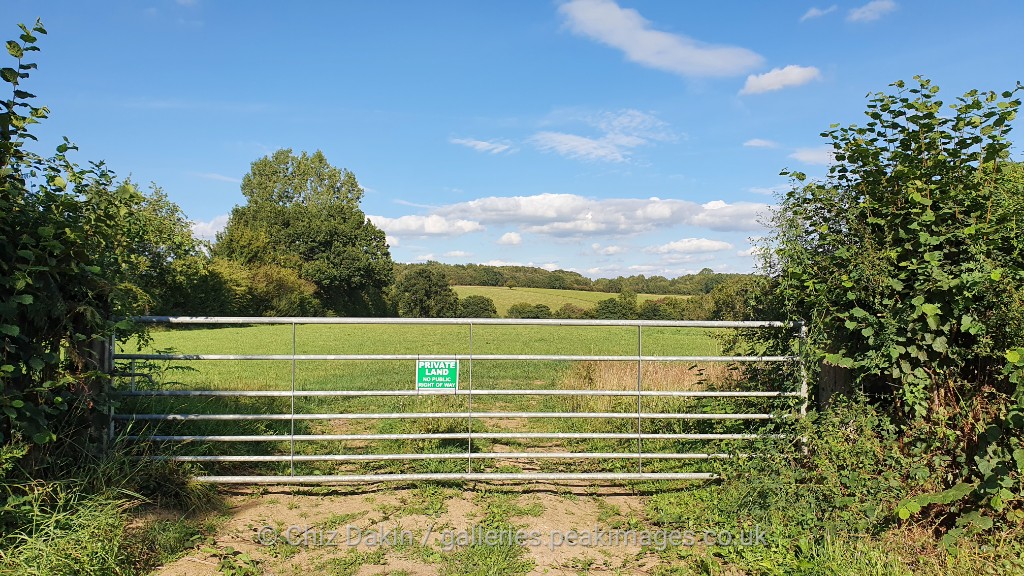
Header Image: “Private Land” © Chiz Dakin/galleries.peakimages.co.uk
