Laurence Rose
The views expressed in this post are those of the contributor and do not necessarily represent the views of all members of the Gritstone co-operative.
Finishing a book a week into lockdown, when that book is all about humankind’s relationship with the rest of nature, seemed at first like unfortunate timing. Publishing it six months later, with pandemic still raging around the world, it’s as if I’d planned it that way all along. I re-read the text and found little I needed to change. Covid seemed to reinforce everything I wanted to say, and it was mostly a matter of slotting in a few mentions of it in appropriate places. But it also seemed appropriate to add a postscript just before committing it to print, so I wrote this:
While the human world was shutting down and locking its doors, the non-human world continued nonchalantly to turn.
One globe spun and tilted, making the days and the seasons happen and calling the birds from across the deserts; the other ground to half-speed, stretching the days and nights, casting the planes from the skies and emptying the streets. I finished this book in the early days of lockdown, and spent the following weeks inhabiting two and a half acres – or 0.000000002% – of the Earth’s surface. It became a world within a world, and I found within it an infinity of other worlds. It was as if social disconnection had made all the other connections plainer, more readable.
At the forgotten beginning of 2020, in Davos-Klosters, Switzerland, the World Economic Forum held its 50th annual meeting. It was exactly three weeks after authorities in China had informed the World Health Organisation of a cluster of viral pneumonia cases of unknown cause in Wuhan. As the Forum opened on 21 January, there were 278 confirmed cases, all but four of them in China.
The 3,000 delegates gathered to review issues of global concern, which, for most of those fifty years have coalesced around the gravitational pull of global capital: wealth management, capital markets, and conventional threats such as international conflict. More recently, the Forum’s annual headline theme has included words like rethink, redesign, new reality, transformation, new models, shared future and, appearing for the first time in 2020, ‘sustainable’. The 2020 theme in full was Stakeholders for a Cohesive and Sustainable World and included several hours’ worth of presentations and debate on the topic How to Save the Planet.
Ahead of the meeting, the WEF published a briefing titled Biodiversity Loss Puts Our Food Supplies and Medical Care at Risk – It Must Be Stopped. It was written not by an environmentalist or an academic ecologist, but by Peter Giger, Zurich Insurance Group’s Chief Risk Officer. Environmental concerns dominated the list of most likely long-term risks presented in the forum’s annual Global Risks Report, which noted that the current rate of biodiversity loss has critical implications for humanity, including the collapse of food and health systems.
Within weeks, that last scenario was suddenly real. The increasingly frequent emergence of new diseases was known to be linked to the degradation of ecological systems. Like some rare astrological alignment, a conjunction of the three great planetary concerns – economic, human and ecological well-being – had shown themselves to be a single, interconnected matter.
The world’s governments will be judged, therefore, on the interconnectedness or otherwise of the response. With no-one holding their breath to await such leadership, local initiatives by people feeling differently empowered have been emerging from the dark shadows of isolation. Flower-rich verges are left uncut, to enliven thousands of British towns and villages. Consortia of farmers have used lockdown to launch initiatives aimed at “making things wilder – not to create space for nature but to find out how we live inside the ecosystem.”
Meanwhile in the July the World Economic Forum published a 111-page report calling for a critical shift towards nature-positive models in the three most damaging economic systems: food, land and ocean use; infrastructure and the built environment; mining and energy. Globally, a $2.7 trillion investment each year to 2030 would create 400 million jobs and $10 trillion a year in long-term business value, it said.
Is it conceivable, in these strange times, that the combined forces of local enterprise and global capital will give up waiting for any political impetus to invest in a green recovery and just do it anyway?
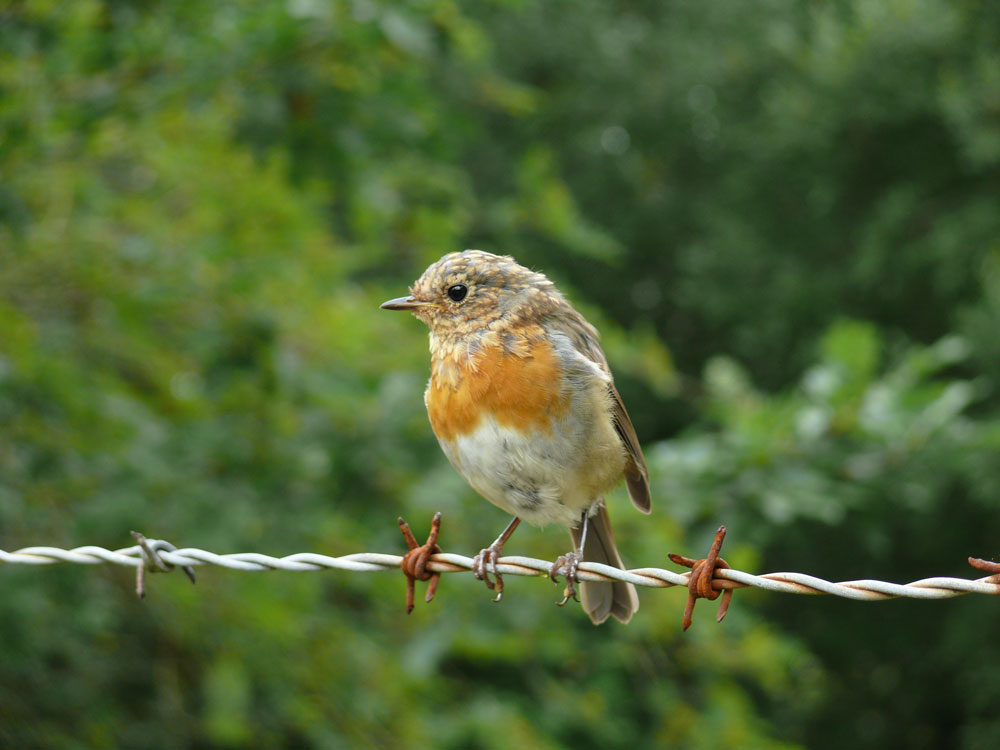
Header Image: Juvenile Robin, © Laurence Rose