Colin Speakman
The views expressed in this post are those of the contributor and do not necessarily represent the views of all members of the Gritstone co-operative.
It has become a commonplace that when the coronavirus pandemic finally ends, hopefully through mass vaccination of the UK population, Britain has the rare opportunity to become a greener society, one in which a respect for and understanding of the natural world will become a major driving force.
Some conception of how this might be achieved lies within the pages of Gritstone author Laurence Rose’s inspiring new book Framing Nature*, which explores the complex relationship between people and wildlife and how much we can benefit by understanding and respecting the natural world around us that ultimately we all depend on for our very existence.
To be fair, many leading politicians are beginning to say the right things. Climate Change is now widely understood as a massive threat to human existence. Words like “Climate Crisis” and “Green New Deal” are now finding their way into speeches and there is a gradual recognition that new technologies are available which could deliver jobs and wealth to replace the thousands lost in the current crisis. Wind power now provides a far higher percentage of our energy than ever before with fossil fuel use now declining. Exciting research is going on in Germany and UK exploring huge possibilities offered by carbon-free Geo-energy. Geothermal energy from deep beneath earth’s surface could be sourced and in the North of England stored in former deep coal mine workings or natural aquifers, or out into the North Sea in former oil and gas wells. Such technologies could prove transformative whilst carbon-produced fracking is now increasingly irrelevant and obsolete.
But such changes by themselves will do little to restore already degraded natural environments or even air quality. The first coronavirus lockdown produced a massive but all too brief improvement in air quality in our towns and countryside which had huge benefits to human health (more people die as a result of air pollution than of coronavirus, whose effects are intensified by air pollution). In contrast the second coronavirus wave has intensified car dependency, with people abandoning public transport. As winter has come, the temporary shift to walking and cycling has reversed. In many areas of the UK traffic levels and pollution are now higher than in February 2020. The switch to electric cars has yet to overtake the massive growth in use of fashionable gas-guzzling SUVs. The Government has not changed its plans for a £27 billion new roads programme, including a huge new trunk road/motorway across and underneath the Peak District National Park to add to gridlocked traffic in Sheffield and Manchester. Yet at the same the Highways Agency is pressing ahead with plans to fill in the 2.25 kilometre Queensbury Tunnel to prevent the construction of the Great Northern Railway Trail – a cycle way linking Halifax, Bradford and Keighley. There are still plans to massively increase carbon-generating Leeds-Bradford Airport despite the collapse of any business case post-Covid.
Despite the grand rhetoric of “levelling up” the North of England to a greener future, there must be deep concern that with a Prime Minister careless about keeping actual promises, when it comes to funding priorities, once again environmental protection will lose out. As Laurence points out, the Government’s main watchdog for nature, Natural England, has been scandalously underfunded and is under constant political pressure from landowning and commercial interests. There is also significant loss post-Brexit of EU funding for nature protection. Local authorities too, including National Park Authorities, have been so weakened and underfunded that they no longer have the resources, for example to maintain local footpaths and bridleways. Many of these are now being trashed and destroyed almost beyond repair by massive increase in usage post-virus, with more people having staycation holidays or driving to their nearest National Park putting popular honeypot locations and wildlife habitats under extreme pressure from both feet and cars.
So yes, during Lockdown we have had opportunity to look at nature in new ways and to recalibrate our relationship with our local wildlife –birds, wildflowers, hedgehogs, insect life, precious woodland. But will this newfound love of birdsong be translated into a determination to hold our elected representatives to task? Can they be made to ensure that in any forthcoming new financial austerity cuts imposed on bodies like Natural England and local authorities to help pay for the coronavirus crisis, front line protection of the natural environment will not be the first and most extreme casualty?
Maybe that is something we all need to hammer home relentlessly to local and national political leaders and decision takers at every level, to ensure, well before 2024, it becomes a key election issue.
*If you haven’t yet ordered your copy of Framing Nature, it’s available at gritstonecoop.co.uk post free for £11.95.
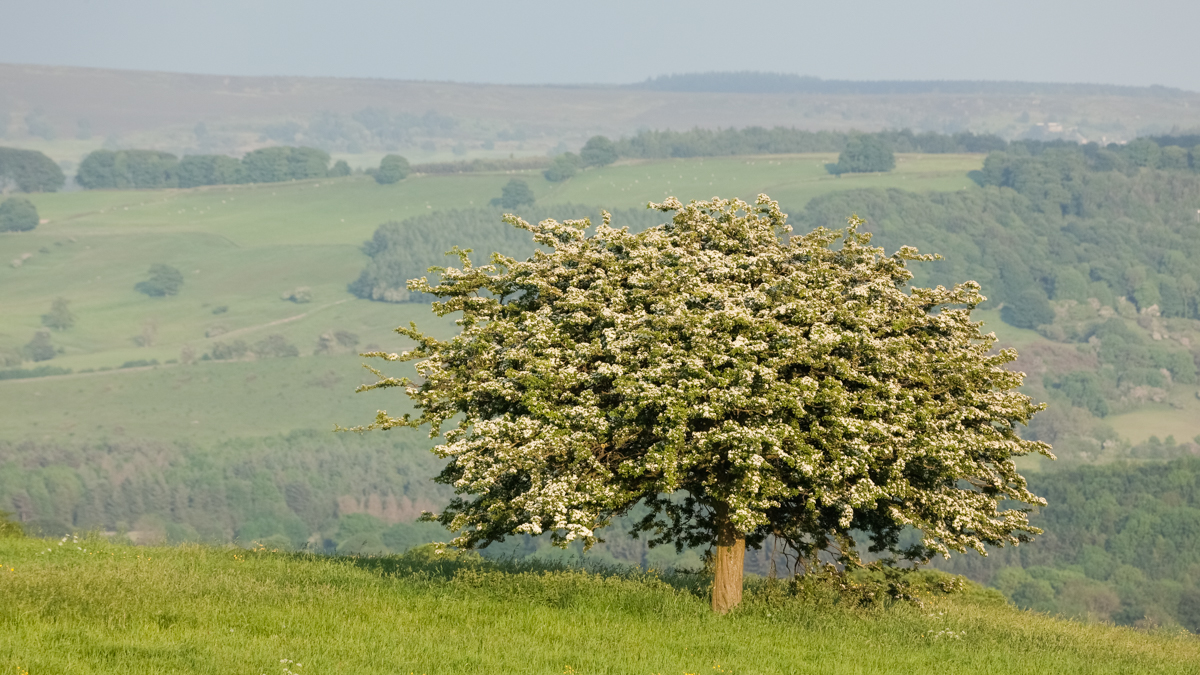
Header image: “Hawthorn in blossom” © Chiz Dakin/galleries.peakimages.co.uk