Laurence Rose
The views expressed in this post are those of the contributor and do not necessarily represent the views of all members of the Gritstone co-operative.
At one minute to four in the afternoon, on Tuesday 21 December, the sun (sol) appeared to be stationary (sistere) for a moment, having reached the farthest point south in its declination, hovering, so it would appear, over the Tropic of Capricorn. The exact moment means little, but for those of us observing from northerly latitudes, the day itself is significant: the last of the days to be shorter than the previous one, following the last of the nights to have grown longer than the one before.
Traditionally, New Year is celebrated at different times by different communities, and not at all by many. Some traditional New Years, such as the Chinese Yuan Dan, or first morning, are at the start of the northern spring. Some, especially those that spring from the stories associated with peoples’ faiths, are at times less obviously connected to natural phenomena. These include Rosh Hashanah, the Hebrew New Year.
It is commonly believed that the dating of Christmas Day, 25 December, was decided upon so that pagan Northerners, most of whom celebrated Yule or some other form of solstice festival, would more readily merge their customs into those of the new faith. However, prior to the mid fourth century the birth date of Jesus was paid little heed. The only evidence that might have enabled the date to be calculated is the Luke Gospel: this explains the Nazarene family’s presence in Bethlehem by their need to comply with a census taking place at the time. The census, however, took place at least ten years later, in 6CE.
Nevertheless, by 381 and the First Council of Constantinople, the date of 25 December was fixed, based on allegorical interpretations of biblical text associating the arrival of Jesus with the return of the world into light, and the return of the sun to its northward declination: in other words the solstice.
So solstice, Christmas and New Year have long been associated – effectively the same thing, separated only by the circumstances involved in fixing dates: the impossibility of measuring precisely the moment of solstice or the exact length of the year in ancient times; the tendency for the old Julian calendar to drift away from celestial reality; and civil corrections in later versions.
But the idea that the natural turning of the year occurs at a defined moment is misleading. Where I live, at 53°35’N in Yorkshire, the solstice may take place at the same time as everywhere else on the planet (in 2021, this was late afternoon on 21 December), but here, nature’s new year began eight days before that. The sun set earlier on 13 December than on any other day of the year, and from the next afternoon until 24 June 2022, the nights will continue to draw out. Meanwhile, imperceptibly, the mornings will continue to draw in until 29 December. These asymmetrical changes happen faster at the end of the day than at the beginning, so the net effect, by 21 December, is for overall daylight time to increase, even though the mornings grow darker for another eight days. The only one of these dates and times that is common to all parts of the globe is the moment of solstice itself.
In these northern lands, the turn of the year was once marked by the tradition of asking small and not so small favours, sometimes in return for payment. The first historic record comes from near here, in the estate accounts for 1443 of Sir Robert Waterton of Methley, West Yorkshire. Waterton paid out twelvepence and eightpence respectively for “large hogmanays” and “small hogmanays”. The accounts are in Latin, apart than the word hagnonayse. The -se ending suggests a Middle English plural version of a Norse word, perhaps as an Anglo-Norman word in England, arriving separately from Viking lands into Scotland, where Hogmanay is as important as ever.
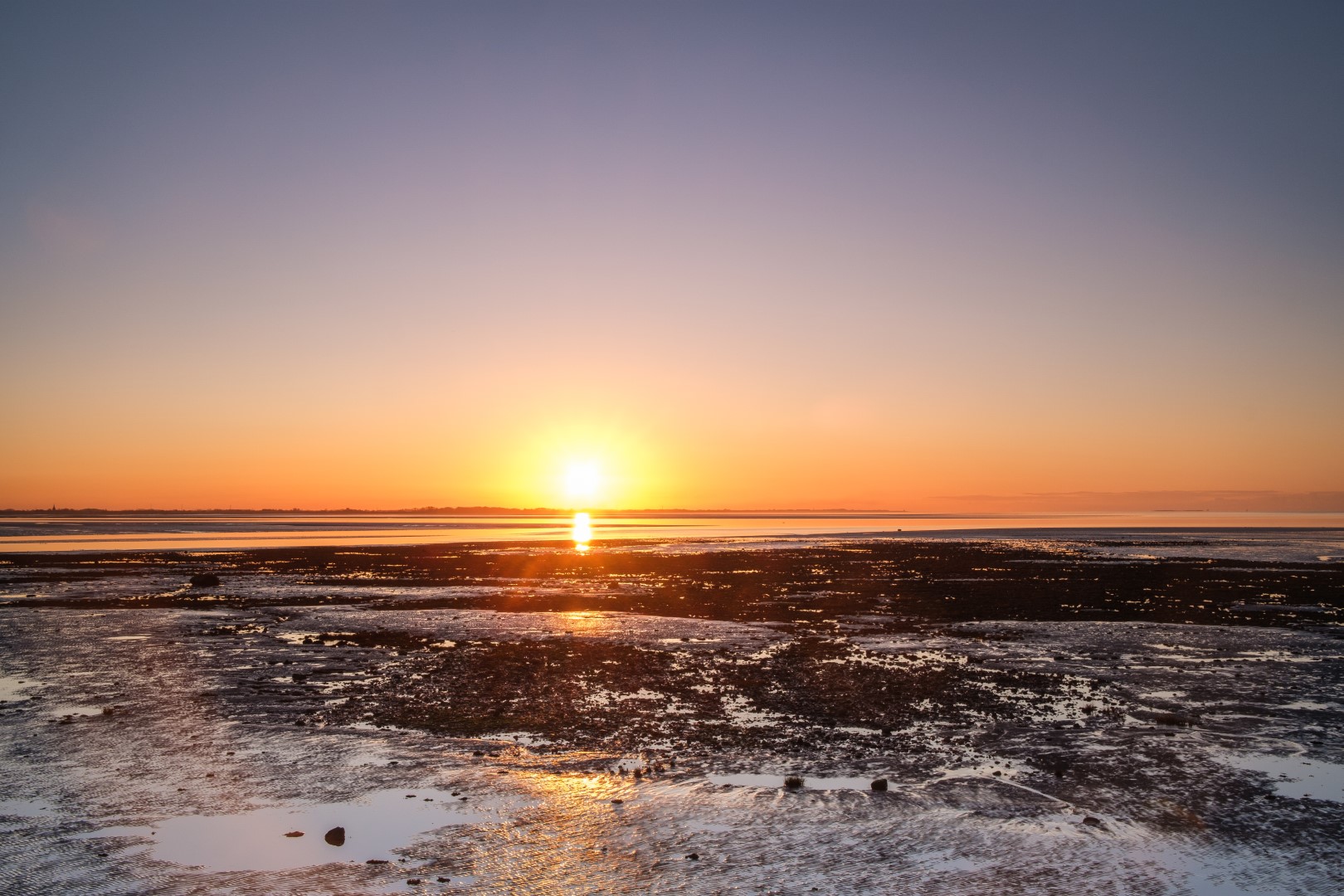
Header Image: Winter sunset © Chiz Dakin/galleries.peakimages.co.uk
