Eileen Jones
The views expressed in this post are those of the contributor and do not necessarily represent the views of all members of the Gritstone co-operative.
Launching a book used to be a straightforward affair. The publisher would advertise an event at a bookshop, the author would make an informal speech, answer a few questions, sign a few books, offer a few glasses of wine.
Now while there are still no “non-essential” retailers open, (how can books be considered non-essential?) it’s necessary to think outside the box, outside the bookshop.
I have a little experience here. In my professional capacity as a publicist, I’ve organised the launch of two books by my Gritstone colleague Andrew Bibby, rather good crime thrillers set in the Lake District. The first involved a geo-cache treasure hunt on a remote fellside above Wasdale, for a clue which was discovered by a very determined navigator in spite of deep snow. The second was a more traditional book-signing in the un-traditional setting of the headquarters of the Langdale Ambleside Mountain Rescue team.
So it seemed appropriate that my book about parkrun should be launched at one of the events, perhaps even the very first parkrun of them all at Bushy Park in London. But parkruns are still off the agenda until June. So why not take a copy of the book there anyway, and present it to the founder of parkrun, Paul Sinton-Hewitt, who still lives near Bushy Park? And how much more fun if a few actual parkrunners could be involved?
That’s how the bookrun relay came about, a book launch which became something much bigger and more significant for a great many people, even those watching on the sidelines. Thanks to the spirit of co-operation and collaboration which is the essence of the parkrun ethos, 105 runners carried the book for 330 miles over seven days in an event organised under strictly Covid-secure arrangements.
We wanted to start at my home parkrun, Fell Foot, the lovely National Trust park at the foot of Windermere. From there I knew how to drive to West London, but how could pedestrians tackle the journey? In stepped Liz Wakelin, an experienced orienteer with a passion for maps. Using a route-planning app called Komoot, she created a line from the Lakes to London on footpaths, dividing the country into seven sections.

The first would take runners from Windermere to Lancaster, and I knew that I could recruit enough friends and colleagues from the parkrun volunteer team to cover that stretch. We decided against splitting the entire length into symbolic parkrun-5k segments as that would be logistically too challenging, and might have changeover points in the middle of nowhere. Instead, we let local runners choose their own distance and, negotiating with the next runners, determine a safe and accessible place to hand over the baton. Due to restrictions in place at the time, runners had to be recruited from their own local area, there would be no more than two on each leg, and the baton – a backpack containing the book – would be handed over at a 2m distance. There would be no night running. (The backpack was customised by day 1 runner Jo Jackson using logos from old parkrun hi-vis jackets.)
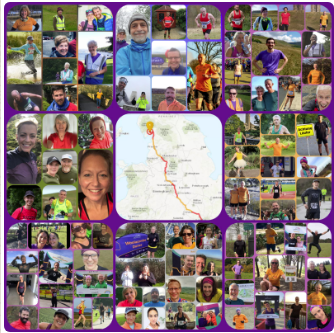
So I could get the book to Lancaster, but what next? I contacted a woman I’d met a couple of times and whose story of her role as a parkrun ambassador – a senior volunteer – was told in my book. Eve Taylor from Macclesfield, former secondary teacher and musician who is a member of the Stockport Triathlon Club, has an enormous network of contacts and an ability to undertake any task without even being asked. She will be Prime Minister in my ideal world. Eve took responsibility for recruiting runners from Lancaster to Worsley Woods near Manchester, and then to Hanley Park near Stoke on Trent, altering the route slightly to take in around a dozen actual parkrun locations. She also subsequently produced a magnificent photo montage of all the 105 runners who took part.
Using social media and friends’ connections, I found another four regional co-ordinators: Phil Sutcliffe, of Lichfield running club, who is head of service, Sensory and Physical Impairment, for Derbyshire County Council (Stoke to Lichfield); Sue Martin from Kenilworth, a former housing association area manager who now works in a secondary school, and is a member of Kenilworth Runners (Lichfield to Warwick); Jenny McBain from Bicester, who teaches English in a secondary school, and is a member of Alchester Running Club (Warwick to Aylesbury); and Chris Kitchener, from Abbots Langley, a ground equipment engineer at Heathrow Airport, who runs for the Dacorum and Tring club (Aylesbury to Bushy Park). All are enthusiastic parkrunners, and used their own contacts, requests in local newspapers and on local radio, and the extensive Facebook community of parkrunners to recruit their regional teams.
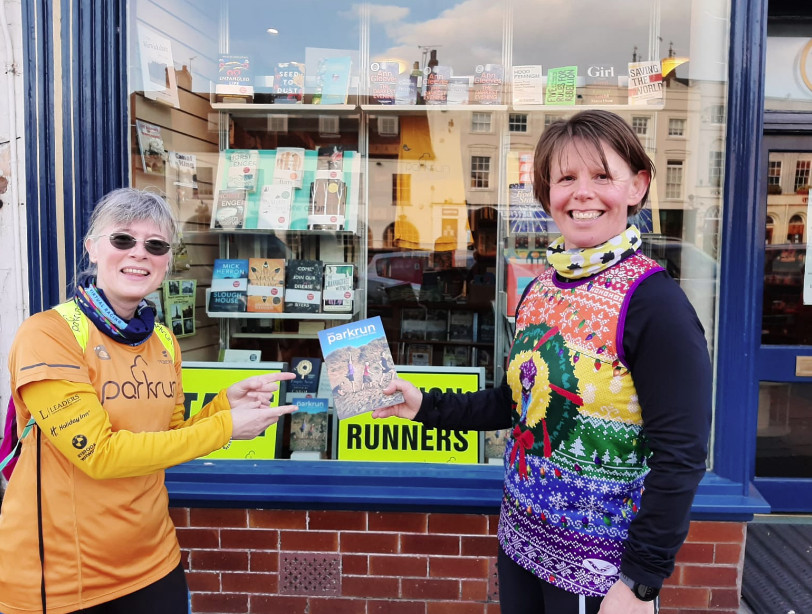
Among them was 11 year old Erin Horseman who ran with her mum, Annabel, on day 6, and Pippa White, who ran the last leg on day 5 and the first on day 6. Pippa persuaded her friends who run the independent bookshop in Warwick, to decorate their shop window in parkrun style. Miriam Lorenzo, on day 6, has yet to run her first parkrun. And on the first section, one leg of the journey was run by Border TV journalist Fiona Marley Paterson whose extensive report on the event was shown on news programmes across several ITV regions.
With a week to go, we were offered the loan of a GPS tracker by James Thurlow of Open Tracking Ltd who worked with Eve Taylor to create an interactive map of the route. This meant that from 9am on Friday March 19 until 5pm on Thursday March 25, the entire journey of the book could be followed on a line moving steadily south eastwards, and proved to be a really cohesive feature for the many people now interested in the event. (We had to turn down literally hundreds of runners who wanted to take part, because they lived too far from the route).
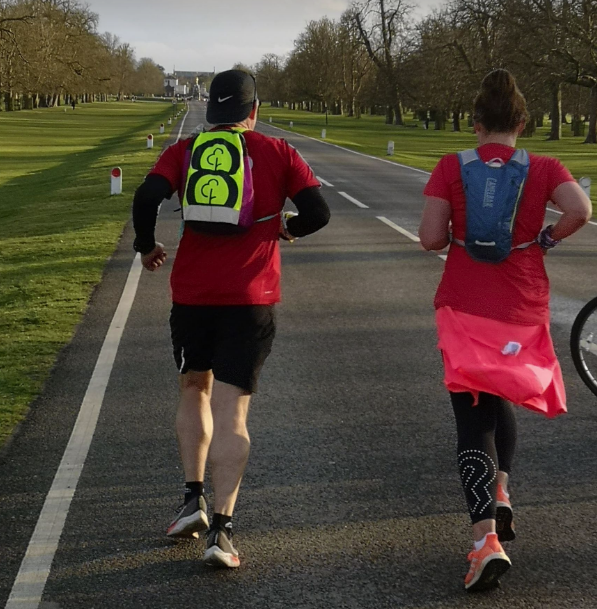
The relay had become far more than a book launch; it had taken on a life, momentum and energy of its own, a team effort of immense proportions given the restrictions under which we were living and operating. So many people missed parkrun during the pandemic. It is, as the book explains, about much more than putting one foot in front of another. parkrun is a community, a force for good in people’s lives, a proven asset for those in social isolation and mental health problems, and even something prescribed by more than 1500 GP practices for patients suffering from a range of conditions. In its absence, this event became a dynamic focal point, a virtual place where the communities could come together again at last. If I tried to thank runners for giving up their time to take part, they in turn thanked me for allowing them to be part of something bigger once again.
“parkrun means being part of a community and sharing fellowship and joy and so much more,” says Eve Taylor.

The book arrived in Bushy Park just five minutes ahead of schedule, carried by Chris Kitchener and Sophie Routledge. They placed it on the ground in front of the founder, Paul Sinton-Hewitt, on exactly the spot that was the start line for the inaugural Bushy Park event. Paul picked it up and opened the bag, and held up the book to the cheers of a very small group of people who were standing nearby. We couldn’t encourage onlookers, spectators, supporters, because of the restrictions in place. But Paul noted that we – safely distanced from one another – numbered 13. The number of runners who took part in his very first time trial from that very spot on October 2, 2004, was 13.
